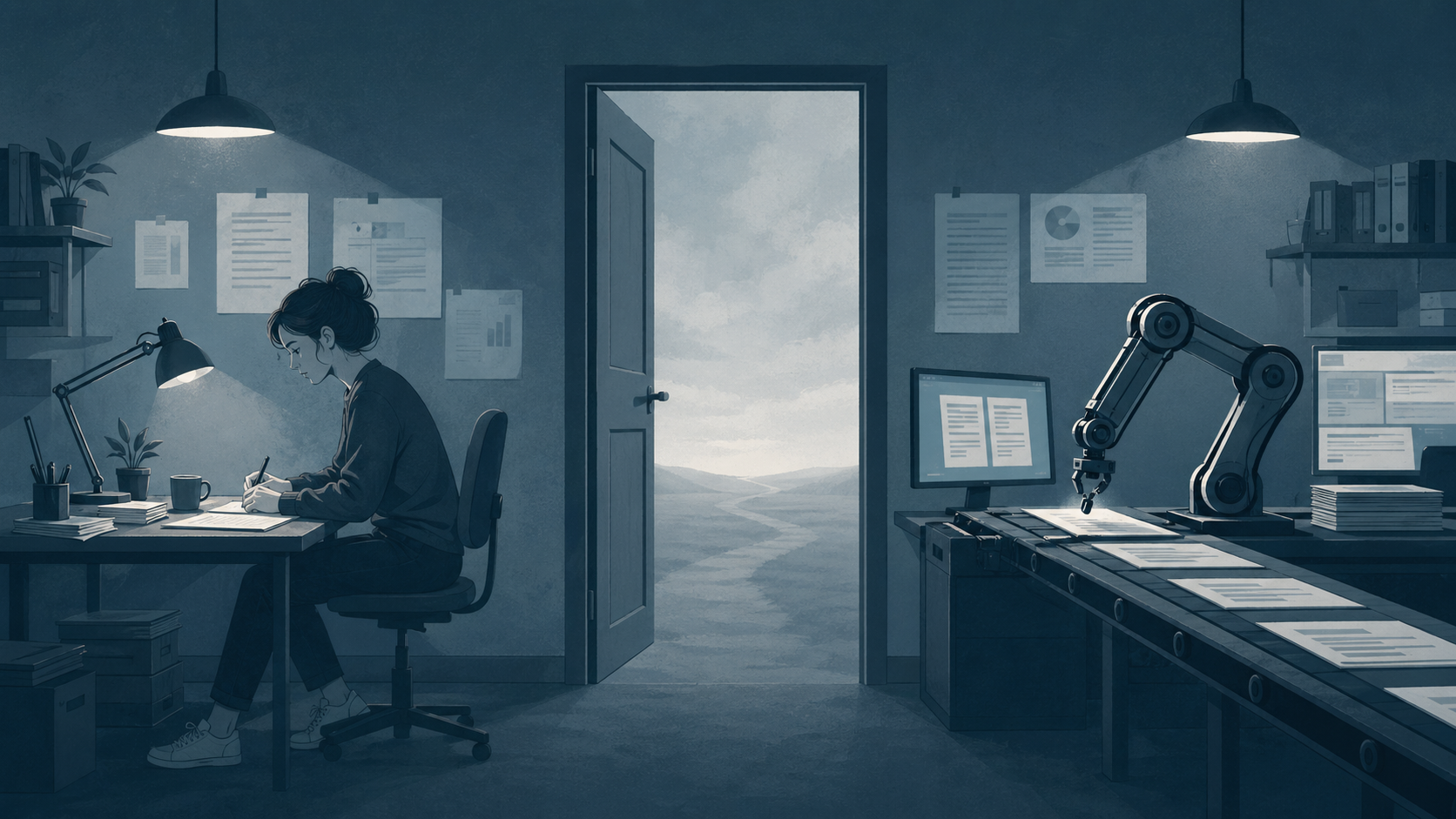
Recently I had to present a group session at work about our company's AI policy.
Policy sessions are not usually the highlight of anyone's week, so I tried to make it more useful. I turned it into a Mentimeter quiz where colleagues could use their phones, answer questions about the policy, and compete for a small prize. Most of the questions were about what the policy actually said, but I added one that was not scored: "In two years, how much of your work will AI be doing? 0%, 25%, 50%, 75%, or 100%?"
Most people answered 25% or 50%. That stuck with me. Our work is about creating learning journeys for international customers, often around leadership behavior, skills development, and organizational change. Generative AI is already helping with certain steps in that process. But could it really take over a quarter or even half of the work? And if it could, what would that mean for the people doing that work now?
Teachers may be asking a version of the same question. Will AI eventually fill in part of what you do when you plan lessons, give feedback, design resources, differentiate materials, or write parent emails? Or is it already doing some of that now?
That is the tension students need to think about too. AI probably will not simply erase every job, but it is already changing what many jobs involve, and young people need something better than panic on one side or empty reassurance on the other.
In short: AI is more likely to change parts of many jobs than erase whole careers. A useful classroom discussion looks at the tasks inside a job, the human skills that still matter, and how people may need to adapt.
AI is more likely to change jobs than simply replace them. Tasks that follow clear patterns, like drafting, summarizing and sorting information, are the easiest to automate, which is why office and knowledge work is affected now, not only factory work. Skills that depend on judgment, trust, communication and working with people are harder to automate and are becoming more valuable.
Most of the evidence points toward job change being more common than total job disappearance. The OECD has argued that, for many workers, AI is more likely to affect the tasks they perform and the way they work than to remove their employment entirely. The ILO has made a similar point about generative AI, saying its impact is more likely to be augmentation than full automation for many roles. That is not the same as saying there is nothing to worry about. If 25% or 50% of your work changes, that can still alter the skills you need, the value you bring, and the way your job is organized. (OECD)
The transition will not affect everyone evenly. The World Economic Forum's Future of Jobs Report 2025 expects major disruption in skills and roles by 2030, with some jobs growing, others declining, and many workers needing to reskill. That matters for students because "AI will create new jobs" is not enough by itself. New jobs may not appear in the same places, at the same time, or for the same people whose current work is changing. (World Economic Forum)
That is why this should not be taught as either a panic story or a comfort story. Students need to understand what AI is good at, where human advantage still matters, and why adaptability is becoming a serious career skill rather than a motivational poster word. The question is not just "Will AI take my job?" It is "Which parts of the work will change, and what will still need a human?"
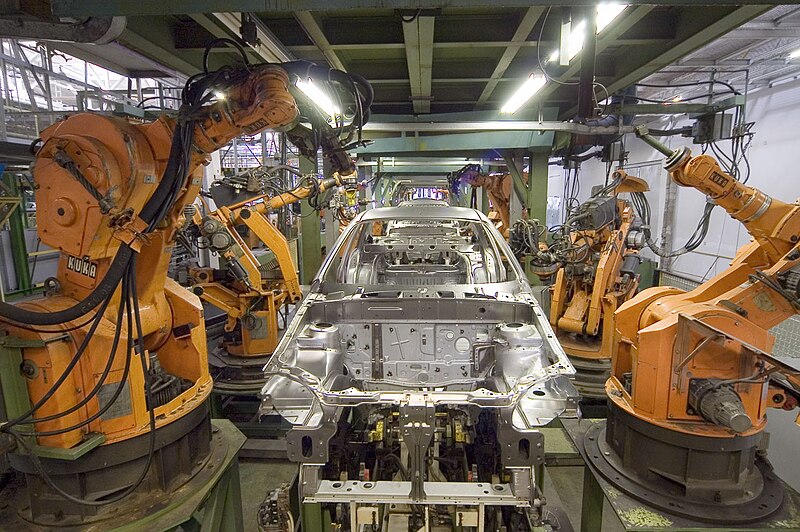
Industrial robots on a factory floor. Automation has been reshaping work for decades. The difference now is that AI is moving into knowledge work too. Photo: Mixabest, CC BY-SA 3.0.
Those questions are the starting point for AI, Jobs and the Future, a group activity for ages 14 to 18 that fits well in advisory, careers, digital literacy, technology, social studies, economics, or future-of-work lessons. Students look at how AI might affect specific jobs, but the activity does not stop at "will this job disappear?" Instead, it asks what AI can do, what humans still do better, which roles are most likely to change, and which skills become more valuable when routine tasks are easier to automate.
| Ages | 14–18 |
| Group size | 3–4 students |
| Time | 60–70 minutes |
| Works for | Advisory, careers, digital literacy, technology, social studies, economics, future-of-work lessons |
The activity is built in three parts. In Part 1, students begin with their own future. They write down a job they might want to do, then make an initial prediction: will AI make that job easier, harder, or obsolete? This gives the discussion a personal stake before students move into the broader labor market.
In Part 2, students analyze specific jobs, including radiologist, translator, journalist, software developer, teacher, graphic designer, truck driver, and therapist. For each role, they look at what AI can already do, what humans still do better, and whether the job is more likely to disappear or change significantly. The key distinction is between full replacement and serious change. A job does not have to vanish for AI to reshape what counts as valuable in that role.
In Part 3, students shift from jobs to skills. They consider why critical thinking, communication, creativity, emotional intelligence, AI literacy, domain expertise, and adaptability may become more important rather than less important in an AI-shaped world. This part helps move the discussion away from vague anxiety and toward practical preparation.
The lesson also includes a teacher guide with timing, facilitation notes, differentiation ideas, and an assessment rubric. The rubric focuses on understanding AI and the labor market, job analysis, skills analysis, group discussion, and quality of reflection, so students are assessed on how carefully they think about change rather than whether they make the "right" prediction.
The main thing to avoid is swinging too far in either direction. Some students will want to say AI will replace everything. Others will dismiss the concern because adults have always worried about new technology. Neither position helps much. Frame the lesson around a more useful question: what part of the work changes?
Where groups may stall is in the jobs table. Students may focus on the job title rather than the tasks inside the job. A "teacher" is not one task. It includes explaining, planning, noticing confusion, managing relationships, giving feedback, motivating students, adapting in the moment, and creating a classroom culture. AI may help with some of those tasks, but not all in the same way. The same is true for developers, designers, journalists, translators, and therapists. If the examples in the table do not feel close enough to students' lives, ask them to choose a job someone in their family does and break that role into tasks. Handle that carefully, though, because some students may be thinking about work that supports their household.
The best discussion often comes when students return to the job they wrote down at the start. Ask them: "Which parts of this job are routine, and which parts depend on judgment, trust, creativity, or human connection?" That question usually makes the conversation less abstract. It also helps students see that preparing for the future is not only about picking a "safe" job. It is about building the skills that make them useful when the work itself changes.
AI, Jobs and the Future is part of the AI, Technology and the Future bundle, a collection of activities that help students think critically about generative AI, future skills, digital tools, and the choices they will need to make as work changes. Use it as a standalone lesson on AI and careers, or as part of a wider sequence on AI literacy, technology, economics, and the future of work.