
My son didn't share that post to cause harm. He shared it because it looked real, it confirmed something he already believed, and seventeen people had already shared it before him. By the time anyone checks, it has moved on.
This is how misinformation is designed to work. It's not a failure of intelligence. And telling him, or your students, to "think critically" doesn't change the habit. Practising the process of critical thinking does.
Misinformation is false or misleading information shared without the intent to deceive, often by people who believe it. Disinformation is false information spread on purpose. For students the useful habit is the same for both: pause, check the source and look for confirmation elsewhere before sharing.
Teenagers are not worse at spotting misinformation than adults. In some ways they're better at noticing that something feels off. The problem is what happens in the gap between that feeling and the "SHARE" button.
Research from MIT found that false news spreads six times faster than true news on social media, and it's not bots doing the sharing, it's people. A study from Yale added something I find genuinely surprising: just asking "is this accurate?" before sharing cuts misinformation significantly. The habit that makes the difference isn't skepticism. It's a brief pause. We can't lecture our kids or students into a habit. They need to practice it.
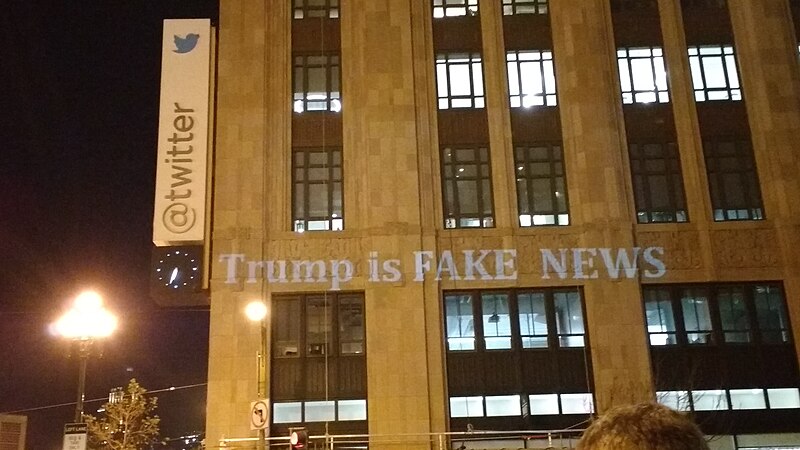
"Fake news" protest projection in San Francisco, February 2017. Photo: Mutante, CC BY-SA 3.0.
That is the thinking behind Detecting Misinformation and Fake News, a free group activity for ages 12 to 18 that fits well in media literacy, digital citizenship, life skills, advisory, or social studies lessons. Students move beyond "think before you share" and practice the actual tools: fact-checking sites, reverse image search, lateral reading, and working through posts that are deliberately ambiguous because real misinformation rarely announces itself. The concrete practice makes checking a habit rather than an extra step.
| Ages | 12–18 (grades 7–12) |
| Group size | 3–4 students |
| Time | 50–60 minutes |
| Works for | Life skills, media literacy, citizenship, advisory periods, school counseling |
This is a 6-page group activity for 3–4 students, built for grades 7–12 and equally usable in college and adult education settings.
The teacher guide covers timing, facilitation tips, differentiation suggestions, and an answer guide for the sample posts. The rubric sits on its own page for easy printing.
The student worksheet has five parts. In Part 1, students brainstorm what makes them stop and question something online, then compare their instincts in the group.
In Part 2, students work through the fact-checking techniques that actually hold up: verification sites, lateral reading, reverse image search, and checking the source before trusting the story. The central habit the lesson builds is simple: pause, check, then share.
Part 3 is where it gets interesting: students work through eight realistic social media posts and headlines, rating each one as true, false, or misleading, and documenting how they figured it out using real tools like Snopes, PolitiFact, Full Fact, Reuters, and Google Reverse Image Search. Some posts are deliberately ambiguous, because real misinformation isn't always obvious.
In Part 4, students pause to check their assumptions as a group. Discussion questions push back on what they thought they knew, including where they went wrong in the sorting exercise.
Part 5 asks the harder question: why do people share false information even when they could check? The reflection page wraps up individually after the group work.
Your teacher guide notes suggest not telling students upfront which posts are false. Being wrong is part of the point.
The fact-checking step is where most groups either click or stall. If they're Googling the headline rather than using the recommended tools, redirect them. There's a difference between searching for confirmation and actually checking a claim, so we make that explicit.
Most students will come in confident. They've grown up online, they feel streetwise about it. God knows my son does! The sample posts are designed to catch that. Some are obvious. A few are not. Let overconfidence meet a wrong answer before you say anything about it. A group that gets Post 5 wrong and then finds out why tends to remember the lesson far longer than one that was warned in advance.
If a student mentions something they personally shared that turned out to be false, let the conversation go there. It's more valuable than any worksheet.
Detecting Misinformation and Fake News is a free download from my store Graphene - Digital Life Lessons on Teachers Pay Teachers. It's part of the Navigating Information Online bundle, six activities covering echo chambers, filter bubbles, conspiracy theories, satire vs. misinformation, and how to read the news critically. Each one works as a standalone session or as part of a sequence, so you can dip in or build a unit. No reason not to grab it and see.
I read each one.