
One thing that comes up constantly in my work designing learning programs is how poorly most of us understand our own emotional responses.
And I do mean most of us. Adults included. We react, we regret, and only afterward do we stop to ask what was actually going on. Was I angry, or embarrassed? Was I stressed, or overwhelmed? Was I annoyed at the situation, or did I feel out of control and need somewhere to put that feeling?
Watching my 16-year-old son navigate this stage of life has made that even clearer to me. Teenagers are often told to calm down, think before they act, or stop overreacting. Sometimes that advice may be well meant, but it is not very useful in the moment. If you do not understand what is happening inside you, "calm down" can sound less like help and more like criticism.
That is the tension this topic sits in: teenagers do not need emotions treated as a problem to fix. They need to understand what emotions are doing, name them more precisely, and build a small gap between feeling something and reacting to it.
Emotional regulation is the ability to notice what you are feeling, understand it and choose how to respond, instead of reacting automatically. It does not mean hiding or suppressing emotions. For teenagers it is a skill that is still developing, and it can be practiced, starting with naming emotions more precisely.
Teenagers are often judged for the size of their reactions before anyone helps them understand what is underneath. A sharp reply, shutting down, walking out, crying, snapping at a friend, spiraling over a message: these are easy to label as drama. But most students are still learning how to notice an emotion before it becomes a reaction.
There is a real developmental reason this matters. During adolescence, the brain systems involved in emotion, stress, reward, and self-control are still changing. That does not mean teenagers are helpless or that every reaction should be excused. It means they are practicing regulation while the equipment is still developing. The American Psychological Association describes adolescent brain development as shaped by biology, relationships, sleep, stress, and context, which is why simple advice like "just calm down" often misses the point. (APA)
The useful skill is not suppressing emotion. It is learning to pause long enough to understand it. Even naming an emotion more precisely can help. "I'm stressed" might really mean anxious, embarrassed, disappointed, overwhelmed, or rejected, and each of those points toward a different response. Research on affect labeling (the practice of putting feelings into words) suggests that naming emotions can support regulation and reduce distress in some situations. That makes emotional vocabulary more than a wellbeing word bank. It gives students a better handle on what is happening before they act. (PLOS ONE)
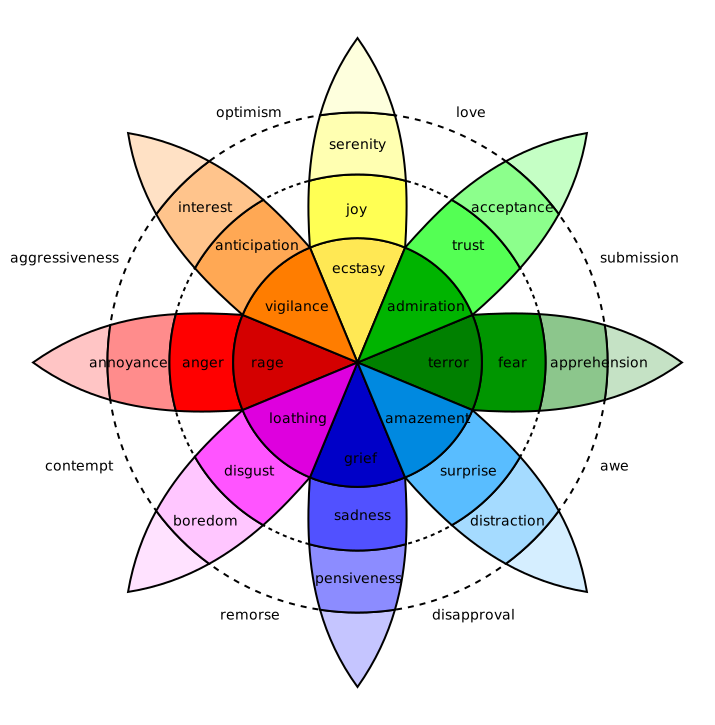
Plutchik's Wheel of Emotions, one model for understanding how emotions relate to each other and vary in intensity. The activity helps students build a more precise vocabulary beyond broad words like "stressed" or "fine." Image: Machine Elf 1735, public domain.
That is the thinking behind Emotions and Regulation, a group activity for ages 14 to 18 that fits well in wellbeing, advisory, life skills, health, SEL, or pastoral lessons. Students explore what emotions are for, build a more precise emotional vocabulary, and look at realistic situations where feelings can turn quickly into reactions. The aim is practical: help students notice what is happening, choose a strategy that might actually work, and understand that regulation is not the same as pretending they feel nothing.
| Ages | 14–18 |
| Group size | 3–4 students |
| Time | 55–65 minutes |
| Works for | Wellbeing, advisory, life skills, health, SEL, pastoral lessons |
The activity is built in three parts. In Part 1, students start with a simple question: what are emotions for? The key idea is that emotions are information, not instructions. Fear, anger, sadness, embarrassment, and anxiety all tell us something. The problem usually comes when we act on the feeling automatically without a moment of awareness in between.
In Part 2, students build their emotional vocabulary. Instead of stopping at broad words like happy, sad, angry, stressed, or fine, they look at more precise words such as anxious, frustrated, ashamed, relieved, lonely, overwhelmed, disappointed, insecure, grateful, and numb. This matters because "stressed" is too broad to be very useful. A student who is overwhelmed may need a different response from a student who feels rejected or embarrassed.
In Part 3, students use a situation tracker. They look at realistic moments like feeling unprepared for an exam, seeing a vague post that seems aimed at them, freezing during a presentation, arguing with a parent or sibling, seeing photos from a party they were not invited to, getting a disappointing grade, or being left on read. For each one, they identify the emotion, where they feel it in their body, and what their first instinct would be.
The lesson then moves into strategies that students can evaluate for themselves, including slow breathing, naming the emotion, taking a physical reset, writing it out, delaying a response, talking to someone, and identifying what they can control. It also includes a teacher guide with timing, facilitation notes, differentiation ideas, and an assessment rubric focused on emotional vocabulary, self-awareness, understanding strategies, group contribution, and quality of reflection.
This lesson works best when students feel they can keep some things private. Make that clear at the start: they can talk about general patterns without sharing personal details, and the reflection section is for them unless they choose otherwise. That helps keep the activity useful rather than performative.
Where groups may stall is in the strategies section. Some students will dismiss strategies quickly because they sound too simple. Slow breathing, writing something down, or waiting 20 minutes before replying to a message can sound obvious until students connect each strategy to a real situation. Push them to be specific: "When would this actually help you, and when would it not?" That question respects the fact that no single strategy works for everyone.
The idea that emotions are information, not instructions, tends to land hardest. Ask students: "What is an emotion you sometimes treat as an instruction?" Anger might tell them to send the message. Embarrassment might tell them to disappear. Anxiety might tell them to avoid the task. Naming that gap between feeling and acting is the core of the lesson, and it is much more useful than telling students to calm down.
Emotions and Regulation is part of the Wellbeing and Mental Health bundle, a collection of activities that help students talk more practically about mental health, digital wellbeing, self-awareness, and the everyday pressures they navigate. Use it as a standalone lesson on emotions, self-regulation, emotional vocabulary, or coping strategies, or as part of a wider sequence on wellbeing and life skills.