
As an educator, you probably see FOMO playing out every day, even when nobody calls it that.
A student walks into class and realizes a group chat kept going without them. Someone sees photos from a weekend hangout they were not invited to. A few students compare who got more likes on a post. Someone checks a story, goes quiet, and suddenly seems somewhere else entirely. None of this has to look dramatic from the outside, but it can land hard.
Social comparison is not new, and it is not a character flaw. Students have always compared themselves with other people: who gets invited, who looks confident, who seems popular, who is doing better. Social media just gives that instinct a constant stream of material. Instead of comparing themselves with a few people around them, students can compare their ordinary Tuesday morning with everyone else's best party, best outfit, best grade, best trip, or best version of themselves.
That is the tension students need to understand: social comparison is normal, but social media gives them unfair inputs. It asks them to measure their real life against everyone else's highlights, and then makes the comparison feel urgent, public, and hard to switch off.
FOMO, the fear of missing out, is the anxious feeling that other people are having better experiences than you, often triggered by seeing them online. Social media makes it constant, because friends' highlights are always visible while their ordinary moments are not. It is closely linked to social comparison, the habit of measuring ourselves against others.
FOMO is easy to dismiss as teenage drama, but the feeling itself is very human. Social comparison has been part of how people judge themselves for a long time. We look at other people and try to work out where we stand: socially, academically, physically, emotionally. The problem is not that students compare. The problem is that social media gives them a very distorted set of things to compare themselves with.
A student is not just seeing one friend's weekend. They are seeing hundreds of people's best moments, edited and selected, all in one feed. Someone's best photo from a party. Someone's highest test score. Someone's vacation. Someone's relationship. Someone's new outfit. Someone's carefully posed "casual" moment. It can start to feel like everyone else is living a fuller, easier, more successful life, even though the feed is not showing the ordinary parts. Research on adolescent social media use continues to point to social comparison as one of the patterns worth paying attention to, especially when it connects to self-esteem, appearance, and feeling left out. (APA)
Telling students to never compare themselves is not a realistic goal. The better goal is to help students notice the appearance-versus-reality gap. What am I seeing? What am I not seeing? What story is my brain filling in? Once students can name that process, FOMO becomes less mysterious. It is still uncomfortable, but it becomes something they can question rather than just absorb.
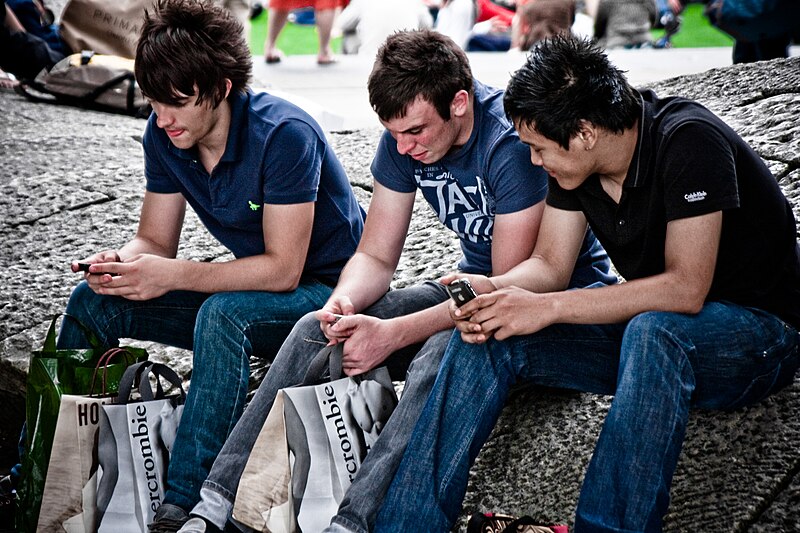
Three people in the same place, each in a different online world. FOMO is not just about missing out on events. It is about the constant awareness that other people's lives are visible, curated, and always available to compare against your own. Photo: Garry Knight, CC BY 2.0.
That tension is the core of FOMO and Social Comparison, a group activity for ages 12 to 18 that fits well in digital citizenship, media literacy, wellbeing, advisory, social media literacy, or life skills lessons. Students look at how FOMO works, why comparison is normal, and how social media can make comparison feel constant and unfair. The activity is not about telling students to stop caring what other people are doing. It is about helping them notice when a feed is giving them a distorted picture, and giving them a more useful way to respond.
| Ages | 12–18 |
| Group size | 3–4 students |
| Time | 55–65 minutes |
| Works for | Digital citizenship, media literacy, wellbeing, advisory, social media literacy, life skills |
The activity is built in three parts. In Part 1, students start by thinking about the last time they felt FOMO, what triggered it, and whether social media has ever made someone else feel FOMO because of what they posted. They then discuss whether FOMO is always harmful, or whether it can sometimes push people toward connection in a useful way.
In Part 2, students work through the comparison trigger table. The situations include seeing photos from a party they were not invited to, seeing a classmate post a higher exam result, watching someone their age share a job or trip they wanted, getting fewer likes than expected, and noticing how much better someone's life looks online than it does in person. For each one, students identify how it makes them feel and what a more useful response might be.
In Part 3, students complete a private FOMO audit. They reflect on habits like checking what others are doing when they are alone, feeling worse after scrolling, posting partly to show others what they are doing, making decisions because they saw others doing something online, comparing their body or achievements, and feeling relieved when someone they compare themselves to has a setback. That last one can feel uncomfortable, but it is often where the most honest reflection happens.
The lesson also introduces JOMO, the joy of missing out, as a counterpoint to FOMO. Students consider what it would mean to feel content where they are, without constantly monitoring what everyone else is doing. The teacher guide includes timing, facilitation notes, differentiation ideas, and an assessment rubric focused on understanding FOMO and social comparison, self-awareness, comparison trigger analysis, group discussion, and quality of reflection.
This lesson works best when comparison is treated as normal rather than embarrassing. Students may not want to admit they feel left out, jealous, or relieved when someone else has a setback. Keep the discussion focused on a pattern that most people experience but few people talk about honestly, rather than on personal confession.
Where groups may stall is on the idea that social media is "fake." That is too simple. A party photo may be real. A high test score may be real. A vacation may be real. The problem is not that everything is fake. The problem is that students are seeing selected moments without the full context. Ask: "What part of the story are you not seeing?" That question helps them challenge the comparison without dismissing the person who posted.
The FOMO audit is usually where it gets honest, especially the question about feeling relieved when someone you compare yourself to has a setback. Handle that gently. Most people have had a version of that feeling, and pretending otherwise does not help. It can open a useful conversation about how comparison can quietly turn other people's lives into a scoreboard, and how students might step back from that before it shapes how they see themselves and others.
FOMO and Social Comparison is part of the Social Media and Digital Life bundle, a collection of activities that help students think more clearly about online behavior, digital wellbeing, media literacy, and the pressures built into social platforms. Use it as a standalone lesson on FOMO, social comparison, likes, exclusion, online highlights, or social media habits, or as part of a wider sequence on digital citizenship and wellbeing.