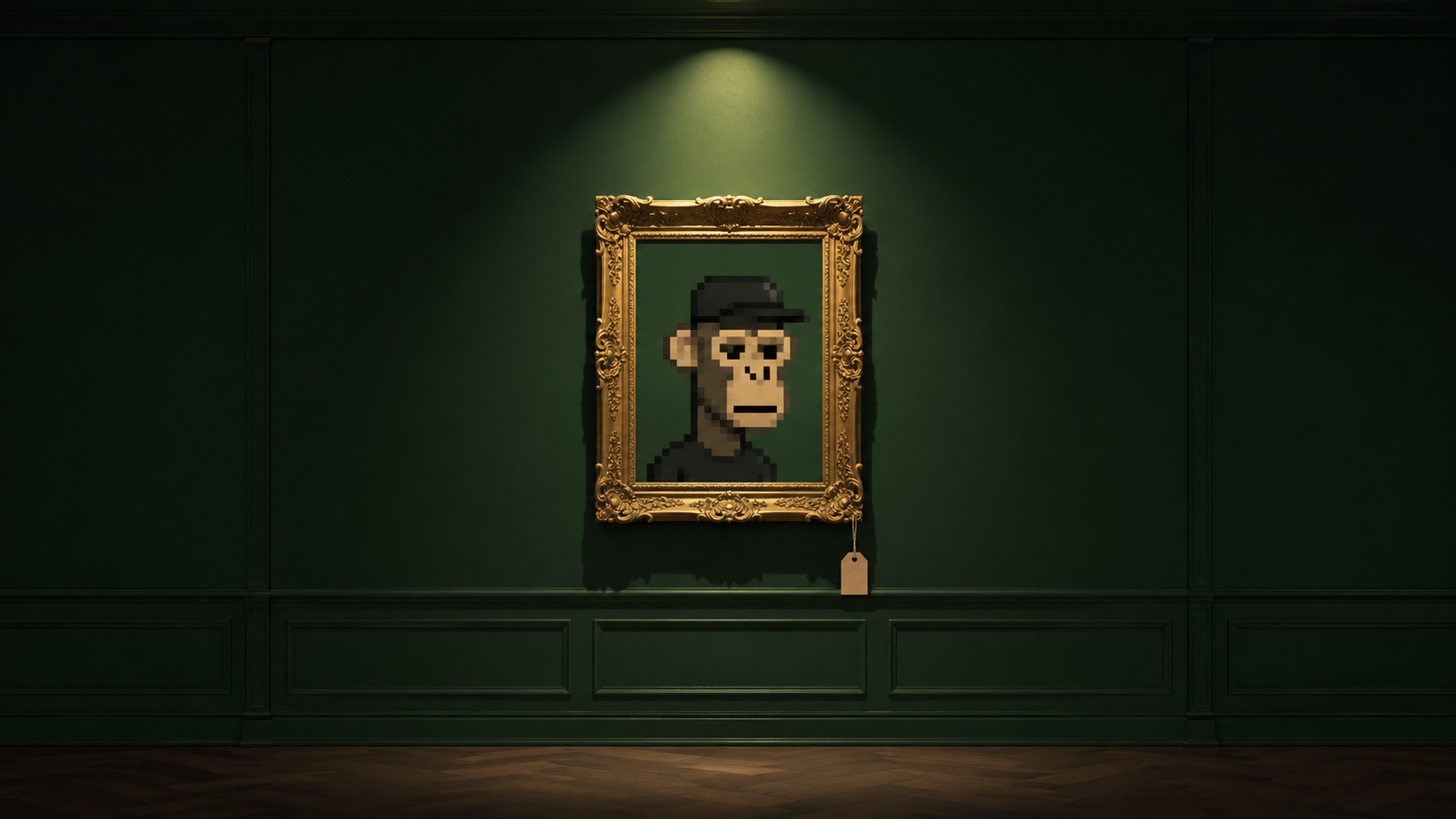
I came across a recent Cold Fusion video on the collapse of NFTs and found myself watching the whole thing, slightly horrified and occasionally laughing. Not at the people who lost money (that part isn't funny) but at the sheer collective derangement of it. In March 2021, a JPEG file sold at Christie's auction house for $69.3 million. In the same month, a screenshot of a tweet sold for $2.9 million. That same JPEG is now reportedly worth around $2,300. The tweet last changed hands for $280.
That's a 99.9% loss. And it didn't happen to one unlucky person. The wider market data is equally blunt: by 2024, 96% of NFT projects were considered effectively dead, with an average lifespan of just over a year. The Bored Ape Yacht Club, once the status symbol of the whole movement at a floor price of $429,000 per ape, had fallen to around $27,000 by 2025. Justin Bieber paid $1.3 million for his. It's now worth roughly $12,000.
Here's what makes this genuinely useful as a classroom topic: it's already over. Nobody in your class is still holding a Bored Ape. That distance makes it possible to analyze the mechanics without defensiveness, and those mechanics are not gone: hype, manufactured scarcity, celebrity endorsement, fake volume, the greater fool theory. They're just operating somewhere else right now.

The Bored & Hungry fast food chain, opened by a BAYC NFT holder exercising the commercial rights that came with their $400,000 cartoon ape. One of the stranger real-world side effects of the bubble. Photo: lazy fri13th, CC BY 2.0
NFTs (non-fungible tokens) are records of digital ownership stored on a blockchain, often linked to an image. In 2021 and 2022 some sold for millions, driven by celebrity endorsements, social media hype and wash trading. Most then lost nearly all their value, which makes the NFT boom a clear case study in how hype can create the appearance of value.
The NFT market didn't grow because the underlying product was genuinely worth more. It grew because of a set of specific, identifiable mechanisms that made it look like it was. Research reported by Bloomberg found that on one major platform, LooksRare, wash trading (sellers buying from themselves using separate accounts to inflate apparent prices) accounted for up to 95% of reported trading volume. The $17.6 billion market that everyone was so excited about was, in large part, invented.
Meanwhile, the people who actually understood the game were explicit about what they were doing. One analyst, reflecting on the period in 2025, told the Australian Financial Review: "We were very much about getting in and getting out within 24 hours." The sophisticated players knew. The celebrities cashing in knew, or should have known. The people left holding the losses were the ones who believed the story.
None of this requires technical knowledge of blockchain to understand. It requires the ability to ask: who benefits from me believing this is worth something? That is a question students can learn to ask about NFTs, about trending stocks, about limited-edition sneakers, about whatever comes next.
I've put together a group activity that gives students practice with exactly this. It's built for economics, media literacy, and citizenship classes, though it works equally well in life skills units and advisory periods. If your students have a phone and a social media account, the question of how hype determines perceived value is already relevant to their lives.
| Ages | 12–18 (grades 7–12) |
| Group size | 3–5 students |
| Time | 60 minutes |
| Works for | Media literacy, economics, citizenship, life skills, advisory periods |
This is a 6-page group activity built for grades 7–12 and equally usable in college and adult education settings.
The teacher guide covers timing, facilitation tips, differentiation suggestions, and a background section on the numbers behind the boom and bust, including the wash trading data and the real-world asset tokenization market that emerged from the wreckage. The rubric sits on its own page for easy printing.
The student worksheet has three parts. In Part 1, students work through a concept table explaining what NFTs actually are, what a blockchain is, and critically, what an NFT buyer was actually getting versus what they thought they were getting. In Part 2, students analyze the four mechanisms that inflated the market: celebrity endorsement, wash trading, FOMO and social proof, and the greater fool theory. Each mechanism has a "how it worked" column and a "the reality" column, and students have to sit with the gap between them. In Part 3, students examine the collapse using a data table comparing peak figures against 2024–2025 outcomes: trading volume, floor prices, platform closures, and the celebrity lawsuits, then answer questions about who knew what and when.
The reflection questions are where it gets interesting. One asks students to apply the NFT cycle to something they observe today. The case study is historical enough to analyze clearly, but recent enough that the next version of it is already forming.
The teacher notes suggest opening with a visual: the Beeple JPEG that sold for $69.3 million in 2021, side by side with its current estimated value of around $2,300. No explanation needed. Show it, let it land, then ask students what they think happened. That contrast does more work than any amount of telling.
The wash trading concept is the one to spend real time on. Ask students: if you saw an NFT selling for $400,000 on the transaction history, would you assume that was a real sale? Why? Most will say yes. That's the point. Inflated transaction histories made the whole market look legitimate, and the mechanism is not unique to NFTs.
The greater fool theory tends to produce good debate. You don't need to believe something has intrinsic value to buy it. You just need to believe someone else will pay more. Ask students to apply that logic to things they know: sneaker drops, limited-edition anything, meme stocks. Where does the chain end, and who is the last person holding it?
For older students, the final reflection question, whether AI valuations today mirror what happened with NFTs, is worth opening up. It's not a rhetorical question. There's a real argument either way, and students who can make that argument with evidence are demonstrating exactly the kind of thinking the activity is trying to build.
NFTs and the Hype Machine is available to download from Graphene - Digital Life Lessons on Teachers Pay Teachers. It's part of the Digital Money & the New Economy bundle, which covers the financial and economic forces shaping teenagers' lives online. Each activity works as a standalone session or as part of a sequence.