
Every now and then, a headline comes along that makes you pause before you know what category to put it in.
When I first saw that The Onion had bought Infowars, my brain took a second to catch up. The Onion is a satirical news site. Infowars was one of the most infamous conspiracy theory platforms online. It sounded like a joke about misinformation eating itself. But it was real. AP reported that The Onion had been named the winning bidder for Infowars in a bankruptcy auction, backed by Sandy Hook families. (The Associated Press)
That is the strange media environment students are trying to read. Sometimes satire looks like news. Sometimes real news sounds like satire. Sometimes misinformation borrows the tone of satire so that, when challenged, the person sharing it can say they were only joking.
Satire is not the problem. Good satire has a target and a purpose. But students need to understand the difference between a joke that exposes something and a false claim that hides behind a joke.
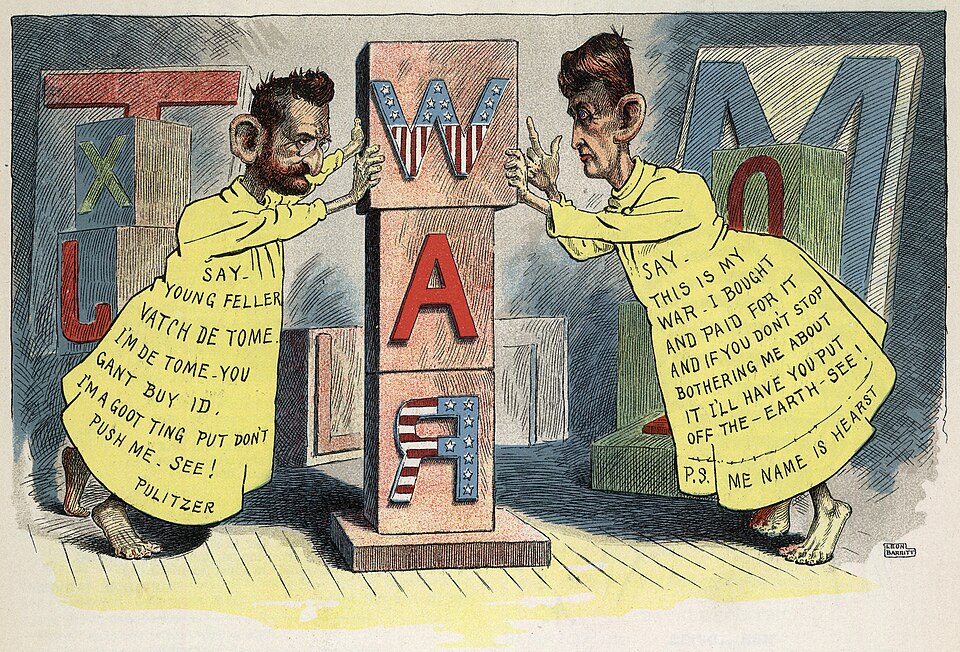
Yellow journalism (sensationalism over accuracy) is over a century old. The tools are new; the pattern is not. Cartoon: Leon Barritt, 1898. Public domain.
No. Satire and fake news can look alike, but they are built for different purposes. Satire exaggerates on purpose to make a point, and it expects the audience to be in on the joke. Satirical news sites like The Onion are open about what they are. Fake news wants you to believe something false.
The trouble starts when satire loses its context. A screenshot without the logo, or a headline shared without the site it came from, can be taken literally. At that point satire can spread like misinformation, even though nobody meant it to.
Satire has always depended on a reader recognizing that something is being exaggerated to make a point. That is easier when the source, format, and context are clear. It gets harder when a screenshot, cropped headline, short clip, or meme moves across platforms without the original cues attached. A student may not see the logo, the author, the date, or the surrounding article. They may just see a claim that looks outrageous enough to share.
The Onion and Infowars example shows how strange this can get. AP reported that The Onion was named the winning bidder for Infowars in a bankruptcy auction backed by Sandy Hook families, after Alex Jones owed more than $1 billion in defamation judgments for calling the massacre a hoax. A real story involved a satirical outlet, a conspiracy platform, and years of harmful false claims. That is exactly the kind of headline students might assume is fake before they know how to check it. (The Associated Press)
Misinformation can borrow the shape of satire: absurd enough to create doubt, but believable enough to spread. Students need to ask what the content is trying to do. Is it making a point through exaggeration, or is it trying to make people believe something false?
The activity Satire vs Misinformation helps students separate humor, criticism, and deception without treating every funny headline as harmless. It is a group activity for ages 12 to 18 that fits well in media literacy, digital citizenship, English, social studies, journalism, advisory, or current events lessons. Students look at what satire is for, sort examples into satire, misinformation, misleading content, or real news, and write their own satirical headline or post with a clear target and point. They notice intent, source, context, and what changes when satirical content is shared as if it were real, without becoming cynical about humor.
| Ages | 12–18 |
| Group size | Groups of 3–5 |
| Time | 55–65 minutes |
| Works for | Media literacy, digital citizenship, English, social studies, journalism, advisory, current events |
The activity is built in four parts. In Part 1, students discuss what satire is for. They name an example of satire they have seen recently, identify what it was making fun of or criticizing, and consider whether there is a difference between a joke and satire. The key idea is that satire is not just "fake but funny." It uses humor, irony, or exaggeration to make a point.
In Part 2, students work through a sorting exercise. The examples include clearly satirical headlines, real news, misleading content, and misinformation. Students decide which category each example belongs in and explain their reasoning, with particular attention to the ambiguous cases. Alongside the sorting exercise, a dedicated comparison table walks through satire versus misinformation across five dimensions: intent, source, how it sounds, what happens when it is shared without context, and how each tends to respond when challenged.
In Part 3, students write their own satirical headline or short post. They choose a target, such as social media companies, politicians using social media badly, influencers promoting products they have never used, or schools banning phones while teachers use them in class. Their satire needs to be clearly exaggerated, but it also needs a genuine point.
In Part 4, students reflect individually. The questions cover what surprised them, how to think about satire that punches down, the responsibility of satirical sites when their content is shared as real, and what they would do differently next time they see something that seems too funny or outrageous to be true.
The teacher guide includes timing, facilitation notes, differentiation ideas, an extension task, and an assessment rubric focused on understanding satire, sorting accuracy, why satire becomes misinformation, the original satire task, and critical reflection.
This lesson works best when students are encouraged to explain their reasoning, not just get the category right. Some examples will be obvious. Others will sit in a messy space between satire, misleading content, and misinformation. That ambiguity is useful. It gives students practice asking better questions instead of rushing to a label.
A tricky moment can come when students say, "It was just a joke." Sometimes that is true. Sometimes it is a way to avoid responsibility. Push gently on the difference between a joke with a target and a false claim with a punchline. A useful question here is: "What is this trying to make people notice, and what is it trying to make people believe?"
The creative task is where many students understand satire more clearly. When they try to write a satirical headline themselves, they have to choose a target, exaggerate it, and still make a point. If the point is missing, it becomes random humor. If the exaggeration is too believable, it can slide toward misinformation. That balance is the lesson.
Watch for satire that punches down. Students may write something funny but cruel, aimed at an ordinary person or a vulnerable group rather than a behavior, institution, or public issue. That is a good moment to ask: "Who is the target, and who has the power in this joke?"
Satire vs Misinformation is part of the Navigating Information Online bundle, a collection of activities that help students think more clearly about misinformation, fake news, bias, source evaluation, algorithms, and the way information spreads online. Use it as a standalone lesson on satire, misinformation, misleading content, fake news, source checking, or media literacy, or as part of a wider sequence on online information and critical thinking.