
My son is 16. When I brought up Andrew Tate in conversation a while back, he gave me the look teenagers reserve for adults who have just revealed how behind they are. He knew who Tate was. He'd seen the content. He thought most of it was stupid. He was not sure why I thought this was news.
I found that moderately reassuring. What I couldn't stop thinking about was the part he hadn't said: that most of it was stupid. Not all of it. And I know enough about how influence works to understand that "most of it is stupid" is not the same thing as unaffected. The messaging is designed to work precisely on the boys who would say that.
What I want to get into here is not Tate specifically, or any one figure. It's the system underneath. Why young men are searching for this kind of content, why the standard responses are not working, and what I think educators and parents can actually do.
The manosphere is a loose online network of influencers, forums and communities focused on men and masculinity, ranging from self-improvement and fitness content to openly misogynistic ideas. Algorithms can lead boys from ordinary content into its more extreme corners quickly. Its appeal often rests on real problems, like loneliness and uncertainty about the future, which is why mocking it rarely works.
A 2024 study from DCU's Anti-Bullying Centre ran a blank TikTok account, no follows, no history, no expressed preferences, and tracked what the algorithm served it. It reached Andrew Tate content within nine minutes. After two to three hours of browsing, somewhere between 76 and 78 percent of what appeared on that feed was classified as toxic. The algorithm is not neutral. It is built to maximize engagement, and for a certain profile of teenage boy, this content engages.
But why does it work?
Survey data from the Survey Center on American Life shows that the share of men reporting zero close friends has increased fivefold since 1990. A 2023 Equimundo report on American men aged 18 to 23 found that two-thirds said "no one really knows me." OECD's PISA data shows boys are now roughly 50 percent more likely than girls to fail all three core subjects. Since 1979, real wages for men without college degrees have fallen around 14 percent.
The manosphere did not create these conditions. It found them, and moved in.
Richard Reeves, in Of Boys and Men (2022), describes the situation clearly: boys are failing at school, failing to build economic footing, and failing to form the kinds of social connections that previous generations built through work, military service, and community institutions that have largely collapsed. The mental health data follows from all of that.
Into that space came voices that said: you're not broken, the system is stacked against you, here is a framework for understanding your life and a community of people who take it seriously. The framework is wrong. In its harder versions it is genuinely dangerous, and the documented pipeline from "men are being left behind" content to misogyny to, in some cases, real-world violence is not a fringe concern. Rationality Rules has a thorough breakdown of how the pipeline works if you want to understand the ideological mechanics.
But the need the manosphere is responding to is also real. This is the life raft problem. The person drowning does not care whether the raft is badly built. They care that it showed up.
A parent or educator who leads with "that's sexist garbage" is not wrong. They are also probably ending the conversation at the only moment it could have gone somewhere. The boy who feels like no one really knows him is not going to be reached by contempt. He is going to find the next person who takes his situation seriously.
Tate was deplatformed from most major social media in August 2022. His audience grew. A 2023 Hope Not Hate survey found that around 79 percent of British boys aged 16 and 17 had consumed his content. That was after the ban. Deplatforming does not close the gap. It moves the content somewhere slightly harder to see and makes it feel more transgressive, which for some audiences makes it more appealing.
The 2024 US election made the political scale of this hard to ignore. Among voters under 30, there was a 31-point gender gap between men and women. Young men shifted roughly 20 points toward Trump compared to 2020. Whatever you think of the politics, a 20-point swing among a demographic in four years is not a blip. The divergence between young men and young women on fundamental questions about society is a trend with its own momentum, and no single ban or election will reverse it.
These numbers matter for classrooms not because schools should be doing political education, but because they show the scale of what we're dealing with. This is not a niche topic. It is shaping how a significant portion of the students in front of you see the world.
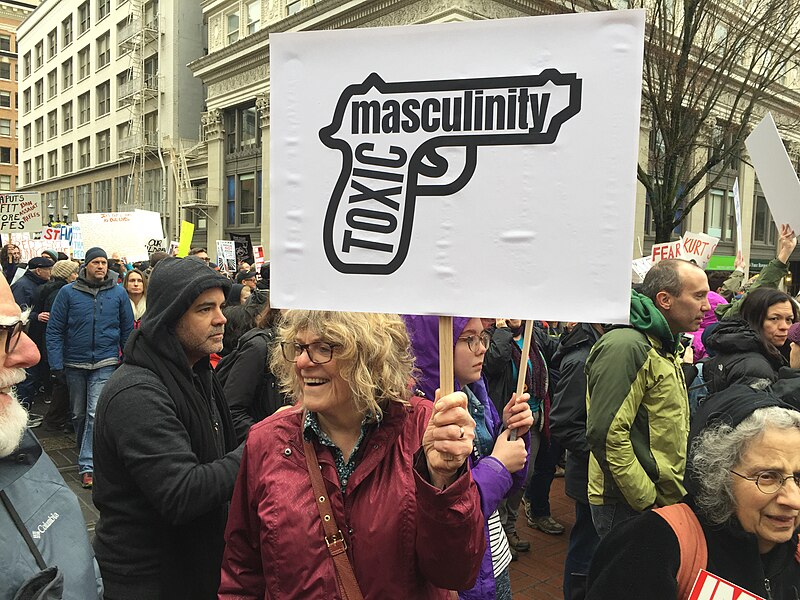
Street art comment on toxic masculinity. Photo: Sarahmirk, CC BY-SA 4.0.
I want to be honest about the limits here. A classroom activity does not fix wage stagnation or the collapse of male friendship. These are structural problems and schools cannot resolve them.
What classrooms can do is something more specific: give young people a space to examine what is actually happening, without the conversation immediately becoming an argument about whether someone's feelings are politically acceptable. That is a different thing from "have the Andrew Tate talk." It is slower, less satisfying as a one-session fix, and more likely to actually land.
What I've seen work starts with the structural facts rather than the ideology. Young men can engage with data about wages, friendship, and school outcomes without immediately feeling accused of something. From there, you can look at how online communities build belonging, how belonging becomes identity, and how identity becomes resistant to outside information. That is a media literacy question as much as a wellbeing one. It also applies to girls. The tradwife pipeline runs through the same ecosystem, and the gender gap in political and social views is widening on both sides.
Give students a framework for understanding why these movements appeal to people who feel the world has stopped making sense for them, rather than handing them a conclusion about Tate, Trump, or any specific figure. That framing shift, from "these people are idiots" to "these people are responding to something real, even if the response is harmful," is the most useful thing a classroom can offer.
I've put together a guide for educators and parents called "Why the Manosphere Keeps Growing: What Educators Need to Know." It covers the research behind what's driving this, the key figures and pipelines worth understanding, and what the evidence says about approaches that actually help. It's written for adults, not students. Sign up to get it.